About Precision Air Balancers L.L.C.

Our Mission & Identity

Precision, Verification, and Environmental Calibration

Founded in Dallas, Texas in 2018, Precision Air Balancers L.L.C. was established with a singular objective: to provide transparent, highly scientific mechanical auditing services for heating, ventilation, and air conditioning systems. The founders recognized that modern building codes were placing immense focus on structural sealing and insulation, leaving mechanical airflow distribution as the primary bottleneck in building performance and occupant comfort.

By specializing solely in testing, adjusting, and balancing (TAB) services, we remain completely detached from equipment sales and replacement contracts. This guarantees that our clients receive unbiased measurements. Whether working directly with mechanical engineers, general building contractors, or property managers, our field data provides a single source of truth regarding how a mechanical system is performing on the ground.

We work inside a strict framework aligning with NEBB, AABC, and ASHRAE procedural standards. Our field technicians carry calibrated tools to evaluate total air handling volumes, thermal exchange coefficients, and fan electrical efficiencies. By calibrating supply damper parameters, measuring return velocity drops, and certifying ventilation dilution rates, we help buildings achieve code compliance and minimize utility expenses.
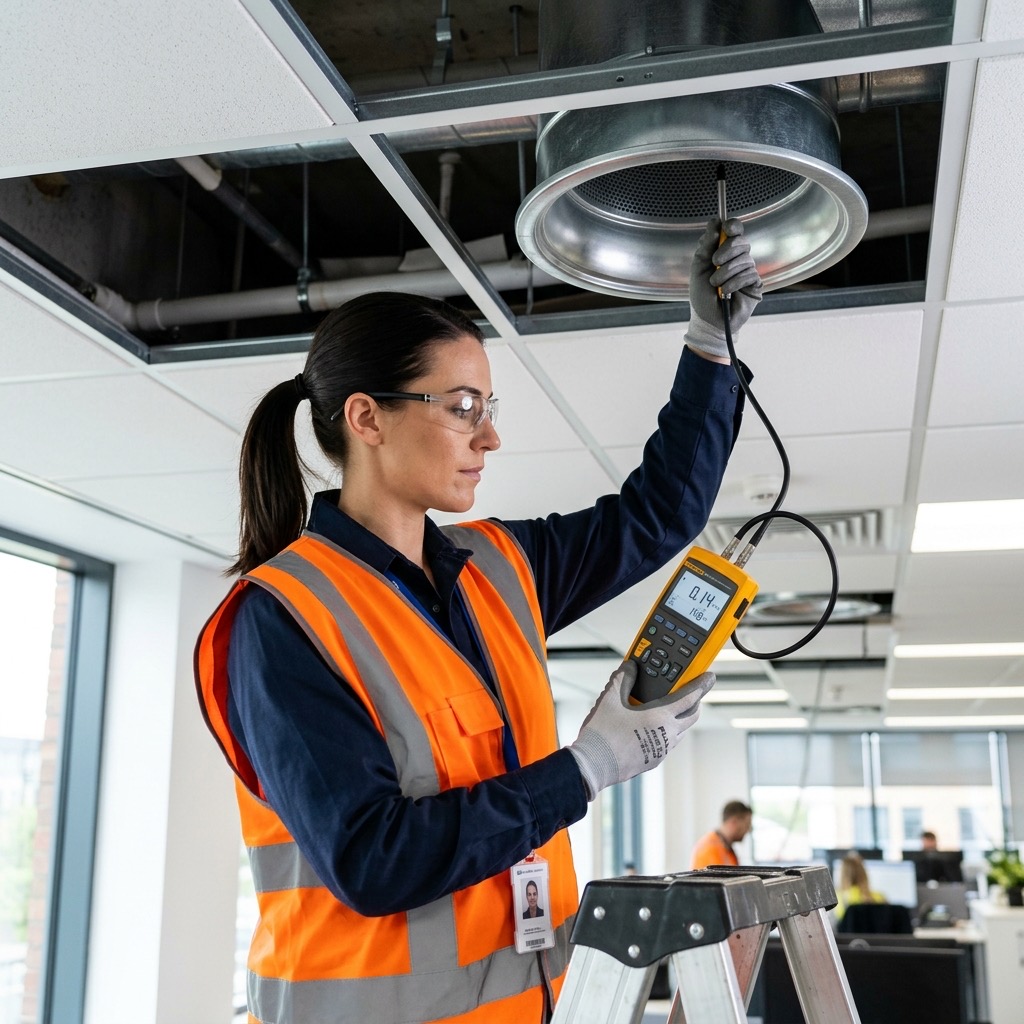

A mechanical engineer calibrating airflow using a digital manometer and hot-wire anemometer

Core Technical Principles

We check mechanical installations against design parameters, adjust airflow volumes utilizing proportional balancing methodologies, and document final system configurations inside a certified TAB document.

Milestones

Our Historical Path in Texas

From a small local inspection crew to one of the most reliable technical auditing services in the region, we have remained committed to testing excellence and scientific accuracy.

2018

Foundation & Licensure

Precision Air Balancers is incorporated in the State of Texas. Our initial crew focuses on residential balancing, zoning testing, and small commercial retail inspections in Dallas County.

2020

Commercial Expansion

We expand our service catalog to cover large-scale commercial duct leakage testing. We acquire state-of-the-art pressure testing blowers to satisfy IECC commercial energy codes.

2023

Mechanical Commissioning

We launch third-party HVAC commissioning services, acting as independent verifiers for complete building systems, evaluating damper control systems and control system code compliance.

2026

Regional TAB Leadership

With over 1,200 commercial and high-end residential mechanical systems certified, we stand as a premier independent mechanical balancing firm in the Dallas-Fort Worth area.

Expert Team

Meet Our Mechanical Auditing Specialists

Our personnel consist of certified TAB technicians, thermal analysts, and environmental commissioning agents with decades of combined mechanical building field experience.

Headshot of Yasser Vance, Senior TAB Engineer and Co-Founder Founder

Yasser Vance

Senior TAB Engineer

Yasser Vance has over fifteen years of mechanical system auditing experience in Texas. He oversees all commercial air balancing operations, specializing in proportional dampers adjustments, HVAC controls integration, and variable air volume systems calibration. He is dedicated to maintaining high standards of testing accuracy.

Headshot of Sarah Lindon, Lead Commissioning Agent Commissioning

Sarah Lindon

Lead Commissioning Specialist

Sarah Lindon directs the third-party mechanical commissioning desk. She is an expert in HVAC building automation systems, building energy codes, and mechanical system ventilation profiles. She verifies that all commercial installations comply with regional energy codes and engineering criteria.

Headshot of Marcus Brody, Field Supervisor Operations

Marcus Brody

Lead Field TAB Technician

Marcus Brody supervises all field balancing and duct pressure testing. He utilizes high-flow capture hoods and digital pressure gauges to check real-time CFM outputs at every diffuser. His detailed field notes form the core of our official mechanical verification reports.

Headshot of Evelyn Vance, Operations Coordinator Support

Evelyn Vance

Operations & Scheduling

Evelyn Vance coordinates client scheduling, compliance filing submission, and technical report drafting. She is the central point of contact for mechanical drawing uploads and schedules, ensuring that field crews arrive with correct blueprints and parameters.

Our Technical Integrity & Standards Alignment

At Precision Air Balancers L.L.C., we believe that our industry credibility is entirely based on the transparency of our measuring procedures. To maintain this integrity, we enforce the following protocols on every project, regardless of scope:

NIST-Traceable Instrument Calibration

Every electronic micromanometer, vane anemometer, thermal sensor, and flow hood is sent to an accredited third-party laboratory every twelve months for calibration against National Institute of Standards and Technology (NIST) reference standards. This guarantees that all reported CFM and static pressure measurements contain less than ±3% measurement tolerance.


Adherence to HVAC TAB Standard Procedures

We follow proportional balancing methods where each supply register in a branch is balanced relative to its neighbors, starting from the most critical terminal. This ensures that when the main system fan volume is set, all outlets receive their design quantities. We also verify minimum ventilation flow rates required by ASHRAE Standard 62.1.


Transparent Code Compliance Certification

We do not alter numbers or adjust data to fit design envelopes. If a mechanical system cannot meet design specifications due to duct design flaws, undersized blowers, or installation damage, we document these issues clearly. Our final reports provide actionable recommendations for corrective mechanical repairs.

Accredited Laboratory Instrument Calibration & TAB Reporting

Our commitment to measurement accuracy requires us to maintain a strict calibration schedule for all our testing instruments. Every digital micromanometer, thermal anemometer, and high-flow capture hood used by our technicians is calibrated annually at an accredited laboratory. This calibration is traceable to the National Institute of Standards and Technology (NIST), verifying that all field data contains less than ±3% measurement tolerance. This level of precision is necessary when certifying critical airflow rates in hospitals, cleanrooms, commercial kitchens, and multi-story office complexes across the Dallas-Fort Worth metroplex.

We also implement internal quality reviews for every project. When field measurements are complete, our supervisors review the raw data sheets, check static pressure calculations, and verify fan law adjustments. We double-check all mathematical conversions between velocity pressure and CFM, verifying that the final report presents a true profile of system performance. Our reports are formatted specifically for municipal code officials and building inspectors, featuring clear tables and diagrams that simplify building clearance. This detailed mechanical verification protects expensive HVAC compressors, extends fan belt lifecycles, and maintains building comfort profiles.

We believe that independent mechanical auditing is essential for building performance. Since we do not sell replacement HVAC equipment or mechanical contracts, we have no incentive to hide installation mistakes or downplay system inefficiencies. We provide objective, scientific readings that verify the building owner gets the mechanical performance they paid for. This protects their capital investment and ensures the facility operates efficiently for years to come.

In addition to airflow adjustments, we inspect control sequences and thermal dampers. We check that fire dampers are fully open and operational, verify that control system sensors match our physical readings, and confirm that automated systems adjust airflow correctly under varying building loads. This comprehensive verification prevents common mechanical control issues, ensuring systems operate reliably under changing weather conditions. By maintaining absolute neutrality, we ensure that our reports stand as a trusted document for municipal building inspectors and engineering consultants alike.

Occupational Safety and Field Auditing Protocols (OSHA Compliance)

Field testing and mechanical auditing require strict adherence to occupational safety guidelines. Our technicians operate in active construction zones, industrial mechanical rooms, and high-voltage electrical environments. To protect our staff and client property, Precision Air Balancers L.L.C. enforces strict compliance with OSHA safety standards on every project. Our technicians are fitted with personal protective equipment (PPE), including electrical safety gloves, hard hats, safety glasses, and high-visibility vests. We perform regular safety checks on all ladders, scaffolding, and electrical testing leads, ensuring that field procedures present zero hazards to surrounding personnel.

We also coordinate with on-site safety managers to establish clear protocols for lock-out/tag-out (LOTO) of mechanical fan motors and electrical switchgear. Before testing any fan pulley or motor speed parameter, technicians isolate and lock the relevant power circuits, preventing accidental motor startup. This careful approach to field operations protects both our field technicians and the client's mechanical assets. Our safety track record is a testament to our commitment to engineering professionalism and site safety, allowing us to maintain a secure environment across all projects in the Dallas-Fort Worth metroplex.

We also coordinate closely with mechanical equipment manufacturers, verifying that all system components (compressors, fans, valves) function according to factory performance curves, ensuring absolute reliability and quality control on every mechanical project.

We verify mechanical parameters and dampers to ensure code compliance on all projects.